Showing posts with label Fields. Show all posts

Monday, 6 March 2017

Flowers are spelling it out...


"I often think flowers are the angels' alphabet whereby they write on hills and fields mysterious and beautiful lessons for us to feel and learn."


Beautiful sentiments from Louisa May Alcott (born 1832), who died on this day in 1888, aged 55. Author of Little Women (1868) Little Men (1871) and Jo's Boys (1886). She was also a transcendentalist, an abolitionist and a feminist.

She is buried in Sleepy Hollow Cemetery in Concord, near Ralph Waldo Emerson, Nathaniel Hawthorne, and  Henry David Thoreau. What a group of people! They are buried on a hillside now known as'Authors' Ridge'.


Monday, 3 October 2016

A Squirrel Buries Its Treasure

A squirrel gets ready for the winter ahead. Henry David Thoreau watched as the little creature carried out its work and later wrote about the scene...


It’s that time of year – autumn, the season of collecting, harvesting and preparing for winter.   The markers of the passing of the seasons are very noticeable in rural areas as humans and non-humans set about preparing for the long, dark months ahead.  The fields and barns have been a hive of activity and indoors, people begin to stock up with winter supplies.  But others too are acutely aware that the seasonal clock is ticking and in the woods, there is much to-ing and fro-ing among the small mammals.  It has been several months since I saw a red squirrel but I have spotted a couple lately while walking in the local forest.  When an opportunity arises and it is possible to observe one from a discreet vantage point, I return somewhat richer and happier for the encounter.

It was after returning from the woods and watching a squirrel going about its business that Henry David Thoreau put pen to paper and recorded the event:

 “I saw a red squirrel run along the bank under the hemlocks with a nut in its mouth.  He stopped near the foot of a hemlock, and hastily pawing a hole with its fore feet, dropped the nut, covered it up, and retreated part way up the trunk of the tree, all in a few moments.  I approached the shore to examine the deposit, and he, descending betrayed no little anxiety for his treasure and made two or three motions to recover the nut before he retreated.  Digging there, I found two pignuts joined together, with their green shells on, buried about an inch and a half in the soil, under the red hemlock leaves.  This then, is the way forests are planted.  This nut must have been brought twenty rods at least and was buried at just the right depth.  If the squirrel is killed, or neglects its deposit, a hickory springs up.”  

( H D Thoreau 
from 
The Journal of Henry David Thoreau)

Thursday, 14 January 2016

Lewis Carroll

            Lewis Carroll 
           (27 January 1832 – 14 January 1898)


 On a snowy day such as this, Lewis Carroll must have had these thoughts and put pen to paper. Today is the anniversary of his death. His works include Alice's Adventures in Wonderland, Through the Looking-Glass, Jabberwocky, and The Hunting of the Snark.  The way he plays with words and uses imagination and fantasy forever appeals to the child within.I love the idea and sentiment of the quote below:

 “I wonder if the snow loves the trees and fields, that it kisses them so gently? And then it covers them up snug, you know, with a white quilt; and perhaps it says "Go to sleep, darlings, till the summer comes again.”


Wednesday, 6 January 2016

Water, water, everywhere


The recent floods here in the north of England have reminded me of the immense power of nature, and that the belief we are in control is merely an illusion that can be shattered all too suddenly.  To stand and watch the waters rising over bridges, submerging roads and fields while man and animal seek out dry land and shelter is both frightening and humbling.  

For several days over the Christmas holiday, I and many other people were drawn to the waters edge, then to stand awe-struck at the expanse in front us.  The river, so gentle-flowing on a summer's day, its murmur whispering an invitation to sit on its peaceful banks and watch the sunlight glistening in its water, was now, a deep menacing sea moving over the fields devouring all in its path, pushing trees, gates, everything out of its way.
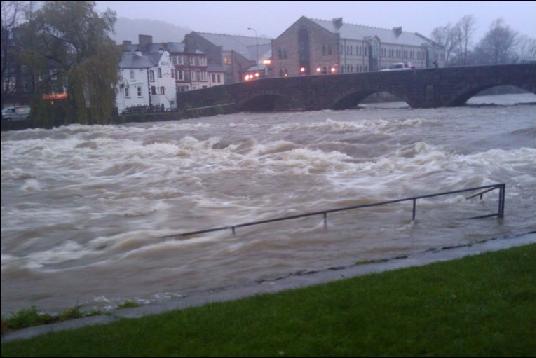

Turkey, presents, and sales were all forgotten as people stood on the road with water lapping at the tips of their wellingtons, looking helplessly at the abandoned cars filled with water.  Standing on higher ground with five or six other people, the only sound was the wind in the trees and the now constant noise of gushing water, running to meet its tributaries, swelling its ranks like an army advancing in power as it progressed.  Indoors, those of us mercifully escaping the trauma of having our houses flooded, listened to the strains of 'The Sound of Music' while outside, even from the garden gate, the river's chorus resonated across the landscape.

For several days, I was struck by the absence of man's noise - the sound of traffic, machinery, human voices, people going about their work and lives.  But it was not total silence, for the wind blew, gale-force, making the trees creak and snap their branches, gates rattled and there was the now constant background noise of the raging river.  Nature's voice rang out across the fields and hills, powerful, dominant, in control while man fell silent, subdued.  People waited, hoped, feared, helped each other, did what they could, powerless against these natural forces.  This was what our fore-fathers experienced, understood, respected. 


"For the most appalling quality of water is its strength.  I love its flash and gleam, its music, its pliancy and grace, its slap against my body; but I fear its strength.  I fear it as my ancient ancestors feared the natural forces that they worshipped.  All the mysteries are in its movement.  It slips out of holes in the earth like the ancient snake.  I have seen its birth; and the more I gaze at that sure and unremitting surge of water at the very top of the mountain, the more I am baffled.  We make it all so easy, any child in school can understand it – water rises in the hills, it flows and finds its own level, and man can’t live without it.  But I don’t understand it.  I cannot fathom its power."

(Nan Shepherd) 

Thursday, 15 October 2015

October Morning Walk

  
I have just returned from a walk. With plenty to do, I shouldn’t have succumbed but the lure of this cold, sunny morning proved irresistible and before I knew it, I was opening the garden gate and walking along the local roads and lanes.  The little voice that usually tries to spoil the fun with ‘you ought to be doing such and such’, didn’t even bother whispering today, for it knew it would be pointless.  At sunrise, I had noticed the pink tipped clouds through the veil of mist, and took my cup of tea out into the garden where the steam from the hot drink mixed with that of my breath.  The cold nipped my fingers and slapped my cheek, rousing me from my sleepy state.  I was fully  awake now, alive to every little nuance, sight, sound and smell around me.  I drank it in.  On going indoors, I washed the breakfast things, immersing my hands in the warm, bubbly water and before I knew it, I was at the gate with coat on and hands deep in my pockets.  Nothing on my mind, just following my own footsteps.


What did I see on my walk this morning?  The sun in one direction, casting its warm rays onto the bodies of the sheep dozing blissfully in the fields.  I saw tree sparrows and green finches zig-zagging across the lane and darting amongst the branches of the trees and hedges, twittering loudly to each other. Rooks called from the tree-tops and a robin increased the volume of his song against the background of their raucous noise. 
I reached a gap in the hedge, a field-gate, and from there I watched the last thin wisps of morning mist fade to reveal nature in her Autumn dress.   No admission charge at this entrance to an exhibition of the highest Art.  Nature is generous and bestows her gifts freely on all who are prepared to stop and look.  The mountains lay in the distance yet every path and chasm was clearly visible.  In the near distance, a group of four or five trees were ablaze, as though red and orange flames were engulfing their leafy canopies.  Green fields surrounded me, laid to pasture, interspersed in places by some that were a pale golden colour following the harvesting of wheat and the cutting of hay.  A brown thread ran here and there between these fields, the recently ploughed rich, dark soil now visible and dotted with black and white specks where rooks and sea-gulls foraged for food.   To my left, spread over the wood like a patchwork quilt were trees and shrubs bedecked in varying hues and shades of yellows, golds, reds, oranges and  browns.


I stood mesmerised by such beauty and drifted out of myself to meet the fields, trees, birds and sky without moving from my vantage point.  I don’t know how long I was gone but I was roused from my trance-like state by the sound of someone saying ‘Thank you.’  
It was me. 

“I'm so glad I live in a world where there are Octobers.”
L.M. Montgomery, 
 Anne of Green Gables