Showing posts with label Man. Show all posts

Wednesday, 8 February 2017

The Relavnce of John Ruskin - On Wealth

At a time of increasing poverty and widening of the gap between rich and poor, the words of John Ruskin give food for thought.


(Feb 8th 1819 - Jan 20th 1900)

"That country is the richest which nourishes the greatest numbers of noble and happy human beings; that man is richest, who, having perfected the functions of his own life to the utmost, has also the widest helpful influence, both personal, and by means of his possessions, over the lives of others.”

"The whole question, respecting not only the advantage, but even the quality of national wealth, resolves itself finally into one of abstract justice."

 "Whereas it has long been known and declared that the poor have no right to the property of the rich, I wish it also to be known and declared that the rich have no right to the property of the poor."

"Large fortunes are all founded either on the occupation of land, or lending, or the taxation of labour."

"... the art of making yourself rich, in the ordinary mercantile economist’s sense, is therefore equally and necessarily the art of keeping your neighbour poor."

"The universal and constant action of justice […] is therefore to diminish the power of wealth, in the hands of one individual, over masses of men, and distribute it through a chain of men."

“What right have you to take the word wealth, which originally meant ''well-being,'' and degrade and narrow it by confining it to certain sorts of material objects measured by money.”

“There is no wealth but life. Life, including all its powers of love, of joy, and of admiration..." 

“Lately in a wreck of a Californian ship, one of the passengers fastened a belt about him with two hundred pounds of gold in it, with which he was found afterwards at the bottom. Now, as he was sinking- had he the gold, or the gold him?”

“What is really desired, under the name of riches, is, essentially, power over men; in its simplest sense, the power of obtaining for own own advantage the labour of servant, tradesman, and artist; in wider sense, authority of directing large masses of the nation to various ends.”


"A little thought and a little kindness are often worth more than a great deal of money."


Thursday, 2 February 2017

James Joyce

Irish writer, James Joyce set many of his works in the city of Dublin but nature was never far away. His descriptions of nature are as vivid as his urban scenes. Her is one of my favourites.


James Joyce 
(2 February 1882 – 13 January 1941)

James Joyce was born on this day in 1882. A fellow Dubliner, he is one of my favourite writers since studying him at school. I didn't tackle the hefty Ulysses until a few years ago when I doggedly ploughed through it. It is hard work but worth the effort. On the other hand, Dubliners and Portrait of the Artist as a Young Man are short but don't be fooled. Though concise, their characters are vivid and complex. Joyce, as he does so well, presents us with real people,full of contradictions,confusions, and troubles that are all recognisably human. Though set in a Dublin before my time, he conjures up the unique  spirit of the place and of the timeless issues that face human beings.  Joyce takes the reader on a journey into a story but also into language. His characters are city dwellers but nature is never far away in his narrations. 

To celebrate Joyce's birthday, I offer you a slice of his beautiful writing.  I hope you enjoy it as much as I do.


Wintry churchyard, Cumbria


“A few light taps upon the pane made him turn to the window. It had begun to snow again. He watched sleepily the flakes, silver and dark, falling obliquely against the lamplight. The time had come for him to set out on his journey westward. Yes, the newspapers were right: snow was general all over Ireland. It was falling on every part of the dark central plain, on the treeless hills, falling softly upon the Bog of Allen and, farther westward, softly falling into the dark mutinous Shannon waves. It was falling, too, upon every part of the lonely churchyard on the hill where Michael Furey lay buried. It lay thickly drifted on the crooked crosses and headstones, on the spears of the little gate, on the barren thorns. His soul swooned slowly as he heard the snow falling faintly through the universe and faintly falling, like the descent of their last end, upon all the living and the dead.”

 (extract from Dubliners)


Thursday, 21 July 2016

Stoicism

A twisted, broken old tree has much to teach us about life, if we would only stand and pay attention to it for a while.


Scarred, broken, its limbs twisted, its trunk gnarled, the old tree stands in the field like a bloodied boxer defiantly carrying on the fight.  Its beauty has long faded and it no longer stands tall and erect but bent and stooped under the heavy blows that the storms of its life have inflicted upon it.  Deep lines and grooves are imprinted on its trunk like the lines and wrinkles on the face of an old man or woman.  Our life experiences, whether we are man, beast of plant, are etched indelibly into our features and our soul.  Beauty has been replaced now by character and the tree draws you in as you observe it and tells its story with every furrow and gash, wound and weakened branch.  It tells of long, dark days and nights and battles with the elements that elicit feelings of pity and sadness for its condition. Perhaps my thoughts have diffused into the atmosphere and the tree has inhaled them with the air, for my eyes are directed more searchingly about the tree. There is more to its story. It is embattled and old yet it stands firm, roots deep in the earth and rock drawing life from the soil and water.  It has felt the heat of the sun, had birds singing from its branches and easy days of just being alive to the universe.  The hard winters give way to spring when renewed energy and new life flow through it.  It knows that life is a process of changing seasons, of ebb and flow, scarcity and plenty.  So it stands there, that old oak tree, telling its tale of stoicism and endurance and faith in the future.

Nature has much to teach us if we only stop and observe.  Trees have an important lesson to share about acceptance and fortitude.  John Cowper Powys (1872-1963), lecturer, philosopher, literary critic, and poet thought that where life is concerned, we should ‘Accept! Defy! Enjoy!'  This philosophy for living is one that could be ascribed to that tree. Powys believed that stoicism and acceptance are important characteristics to develop for they are the means to a more contented life.  He wasn’t saying that we can’t or shouldn’t change things, quite the opposite, for he firmly believed in our ability to create change.  But there is a right time for action and sometimes we have to just ride out the storm, accept things as they are for the time being, and carry on with courage, enjoying the small pleasures available to us.  Fighting, raging inside about a particular situation can make matters worse and achieve nothing but more suffering and unhappiness.  Sometimes, it is better to bide our time, cope with the prevailing conditions, weather the storms of life and when they subside, act, fight, create change, do whatever needs to be done.  Stoicism is almost an old-fashioned word and idea now but it a useful tool with which to arm ourselves against the inevitable storms of life. 


Wednesday, 6 January 2016

Water, water, everywhere


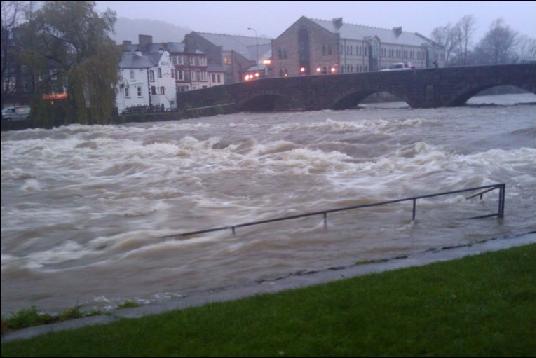
The recent floods here in the north of England have reminded me of the immense power of nature, and that the belief we are in control is merely an illusion that can be shattered all too suddenly.  To stand and watch the waters rising over bridges, submerging roads and fields while man and animal seek out dry land and shelter is both frightening and humbling.  

For several days over the Christmas holiday, I and many other people were drawn to the waters edge, then to stand awe-struck at the expanse in front us.  The river, so gentle-flowing on a summer's day, its murmur whispering an invitation to sit on its peaceful banks and watch the sunlight glistening in its water, was now, a deep menacing sea moving over the fields devouring all in its path, pushing trees, gates, everything out of its way.


Turkey, presents, and sales were all forgotten as people stood on the road with water lapping at the tips of their wellingtons, looking helplessly at the abandoned cars filled with water.  Standing on higher ground with five or six other people, the only sound was the wind in the trees and the now constant noise of gushing water, running to meet its tributaries, swelling its ranks like an army advancing in power as it progressed.  Indoors, those of us mercifully escaping the trauma of having our houses flooded, listened to the strains of 'The Sound of Music' while outside, even from the garden gate, the river's chorus resonated across the landscape.

For several days, I was struck by the absence of man's noise - the sound of traffic, machinery, human voices, people going about their work and lives.  But it was not total silence, for the wind blew, gale-force, making the trees creak and snap their branches, gates rattled and there was the now constant background noise of the raging river.  Nature's voice rang out across the fields and hills, powerful, dominant, in control while man fell silent, subdued.  People waited, hoped, feared, helped each other, did what they could, powerless against these natural forces.  This was what our fore-fathers experienced, understood, respected. 


"For the most appalling quality of water is its strength.  I love its flash and gleam, its music, its pliancy and grace, its slap against my body; but I fear its strength.  I fear it as my ancient ancestors feared the natural forces that they worshipped.  All the mysteries are in its movement.  It slips out of holes in the earth like the ancient snake.  I have seen its birth; and the more I gaze at that sure and unremitting surge of water at the very top of the mountain, the more I am baffled.  We make it all so easy, any child in school can understand it – water rises in the hills, it flows and finds its own level, and man can’t live without it.  But I don’t understand it.  I cannot fathom its power."

(Nan Shepherd)